The Landon Model by Rohit Homes: Front-Attached Duplex Designed for Modern Living in Keswick
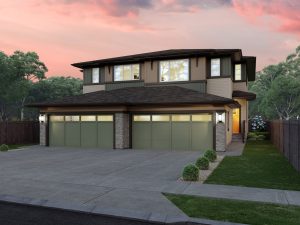
Southwest Edmonton’s Keswick community is known for stylish architectural streetscapes, family-friendly design, and thoughtful planning — and the Landon floor plan fits into this neighbourhood beautifully. Unlike the traditional duplex model seen in many parts of Edmonton, the Landon has been designed with a distinctive front-drive garage on both sides, giving it the elevated look and feel of a detached home while still offering paired-home affordability.
This carefully crafted design makes the Landon an ideal option for buyers who want the convenience of a front-attached garage, the curb appeal of a full front elevation, and the lower price point of a duplex.
Modern duplex elevation of the Landon floor plan in Keswick, Edmonton.
What Makes the Landon Floor Plan Different?
The Landon isn’t a typical duplex. Its layout and exterior design are intentionally created to deliver:
✔ Dual Front-Attached Garages
Each side of the duplex features its own full front-drive garage — a rarity in Edmonton market paired homes.
This gives homeowners:
Direct parking and home entry
Potential separate entrance for future basement suite
Improved winter convenience
A wider, more premium-looking façade
Better separation between units
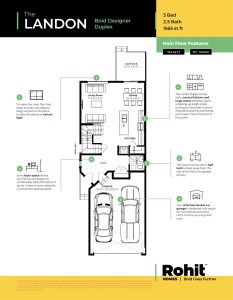
✔ A Spacious, Thoughtful Main Floor Layout
The Landon is designed around open-concept, functional living. The main floor typically includes:
A bright and open living room
A well-proportioned dining area
A stylish, modern kitchen with island
Thoughtful placement of windows for natural light
Convenient mudroom or garage-entry space
This creates a comfortable flow ideal for families, entertaining, or everyday routines.
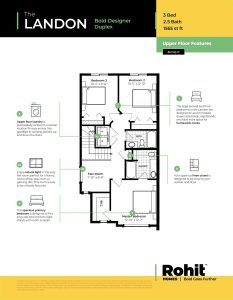
✔ Upper Floor Designed for Families
Depending on the specification, the Landon features:
3 generously sized bedrooms
A full primary suite with ensuite
A second full bathroom
Upstairs laundry
Linen closets and storage solutions
The Landon’s upper floor design balances privacy, function, and comfort, making it an excellent choice for young families, roommates, or multi-generational living.
Designer Interior Packages Bring the Landon to Life
One of the Landon’s biggest selling features is the availability of Rohit Homes’ curated designer interiors. This means your home is professionally designed from top to bottom using cohesive styles such as:
Neo Contemporary Classic
Ethereal Zen
Haute Contemporary
These packages give the home a polished, magazine-ready look the moment you walk in — without the stress of picking every detail individually.
Ethereal Zen
Haute Contemporary
Neo Contemporary Classic
⭐ The Landon’s Exterior: Premium Duplex Curb Appeal
Because both sides of the Landon feature front garages, the entire building has a much more substantial presence from the street. Buyers love this because:
It feels like a single-family home from the outside
It allows for wider entry and architectural detailing
It improves symmetry and exterior appeal
It blends beautifully into Keswick’s architectural standards
This is especially important in Keswick, where exterior coordination is a key part of the community aesthetic.
⭐ Who Is the Landon Floor Plan Best Suited For?
The Landon is a perfect match for:
🏡 First-Time Buyers
Who want a stylish, functional home without stretching their budget.
👨👩👧 Growing Families
Who need multiple bedrooms, extra storage, and comfortable shared spaces.
🚗 Buyers Who Want a Front-Attached Garage
Without the cost of a detached single-family home.
🧑💼 Professionals or Couples
Seeking modern design and low-maintenance living in an upscale community.
🌿 Those Wanting to Live in Keswick
But prefer a more affordable entry price point.
⭐ Why the Landon Is a Standout in Keswick
Keswick is one of the most sought-after communities in Southwest Edmonton, known for:
River valley access
Stunning trail systems
Excellent schools
Proximity to Windermere amenities
High architectural standards
The Landon floor plan fits this environment perfectly, offering:
Elevated curb appeal
Practical layouts for everyday living
Beautiful designer finishes
Front-attached convenience
Exceptional long-term value
It’s a model that appeals to a wide range of buyers while enhancing the already beautiful Keswick streetscape.
⭐ Interested in Touring the Landon or Seeing Available Units?
If you’re exploring new construction homes in Keswick — or if the Landon floor plan feels like the right fit — I’d love to guide you through the next steps.
📲 Contact Chris Reid
Century 21 Leading
Your Edmonton New Home Specialist 780-717-5267
Rural Strathcona County Real Estate Market Update – December 2025
Welcome to your December 2025 Rural Strathcona County Acreage Real Estate Market Update. As the year comes to a close, it’s time to reflect on the performance of the acreage market in this highly desirable region just east of Edmonton. Whether you’re looking to buy, sell, or invest in acreages in 2026, this comprehensive analysis—based on the latest statistics—will provide the insight you need to make smart decisions.
Rural Strathcona County is a unique and sought-after real estate market that continues to attract buyers looking for space, privacy, and a balance between country living and urban access. From executive estate homes to hobby farms, this area remains a hotbed of activity—and the data confirms it.
Let’s dive into the performance metrics for December 2025, compare them to last year, and examine trends across sold listings, pricing, days on market, new inventory, and more.
📊 December 2025 Snapshot at a Glance
According to the official statistics:
Total Sales: 13 rural residential properties sold in December 2025
New Listings: 21 new acreages were listed
Average Sold Price: $841,754
Average List Price: $924,961
Median Sold Price: $765,000
Average Days on Market: 72 days
Average Price per Square Foot: $469.56
Sale-to-List Price Ratio: 96.5%
🔄 Year-over-Year Comparison (December 2024 vs. December 2025)
To better understand how the market has evolved, let’s compare these numbers to December of the previous year:
Metric
Dec 2025
Dec 2024
% Change
Sold Properties
13
12
↑ 8.3%
Average Sold Price
$841,754
$786,900
↑ 6.97%
Median Sold Price
$765,000
$695,000
↑ 10.07%
Average List Price
$924,961
$874,550
↑ 5.76%
Average DOM
72
78
↓ 7.69%
Sale-to-List Ratio
96.5%
95.2%
↑ 1.3%
This data reveals a market that is steady and competitive, with a strong list-to-sale price ratio, and healthy year-end demand despite the typical seasonal slowdown.
Bar graphs below are interactive
Strathcona County -Acreage Listings
📥 New Listings – A Healthy Year-End Supply
21 new listings came to market in December—providing ample options for serious buyers still shopping before year-end or planning for early 2026. This number is consistent with historical norms and shows that sellers remain confident in the market.
If you’re thinking of listing in the spring, now is the time to start preparing, as the market remains active and inventory resets in January.
Strathcona County – Average Acreage List Price
📈 Asking Prices Continue to Rise
The average list price for acreages in December 2025 reached $924,961, up from $874,550 last year. This 5.76% increase reflects rising land and construction costs, continued interest in rural living, and perhaps sellers pricing in recent upgrades or renovations.
Sellers should take note—well-presented acreages in desirable areas are still commanding premium asking prices, especially those offering turnkey conditions, outbuildings, or modern amenities.
December typically brings a slowdown in real estate activity due to winter weather and the holidays. However, 13 sales in the rural Strathcona acreage market is a respectable total, representing an 8.3% year-over-year increase. This suggests that buyers are still active, especially those with specific relocation or move-in deadlines tied to the new year.
This sales activity also indicates that acreage living continues to appeal, even during slower months—proof that Strathcona County remains a top destination for lifestyle-driven buyers.
Average Sale Price
💰 Sold Prices Show Confidence in Market Value
The average sold price for the month was $841,754, up nearly 7% year-over-year. Notably, the median sold price rose more than 10%, from $695,000 in 2024 to $765,000 in 2025. This suggests that middle-tier acreage homes are seeing particularly strong interest.
While buyers are still price-conscious, they’re willing to invest in acreage properties that offer strong value, unique features, or proximity to Sherwood Park and key commuter routes.
Strathcona County Acreage Average Days on Market
🕒 Days on Market Decrease – Homes Are Selling Faster
Homes sold in December 2025 spent an average of 72 days on market, down from 78 days the year before. This 7.7% improvement highlights growing market efficiency.
Even in December, when DOM typically increases, rural properties that are well-marketed, well-priced, and show-ready are moving faster than in previous years. Buyers are acting more decisively, especially in areas with limited inventory.
📊 2025 Year-to-Date Comparison vs. 2024
Here’s a full snapshot of how the market performed year-to-date from January through December:
Metric
2025 YTD
2024 YTD
% Change
Sold Properties
342
324
↑ 5.56%
Average Sold Price
$881,000
$792,000
↑ 11.2%
Average List Price
$1,027,000
$957,000
↑ 7.31%
New Listings
490
524
↓ 6.49%
Average Days on Market
67
73
↓ 8.2%
Ask-to-Sell Ratio
96.8%
95.1%
↑ 1.79%
This year-over-year data cements the strength and resilience of the rural Strathcona acreage market. Despite tighter inventory, both pricing and sales volume have improved, and homes are selling faster and closer to asking.
🛠️ What Buyers Are Looking For
Buyers in this market continue to prioritize:
Move-in ready acreages with updated interiors
Functional outbuildings (shops, barns, garages)
Good commute access to Edmonton or Sherwood Park
Modern mechanical systems (septic, well, heating)
Acreages with mature landscaping and privacy
Homes that meet these criteria tend to sell faster and closer to list price—even in the winter months.
📦 What Sellers Should Know
If you’re considering selling your acreage, here are three important tips based on market behaviour:
Don’t wait until spring – Many buyers are already actively looking and serious in Q1. Beat the rush by listing in January or February.
Prepare thoroughly – Get septic, well, and heating systems inspected in advance, and declutter indoor and outdoor spaces.
Price competitively but confidently – The data supports upward movement in sold prices and strong list-to-sale ratios.
With buyer demand still outpacing supply in certain sub-markets, it’s an excellent time to capitalize on the momentum.
📌 Local Market Trends to Watch in 2026
Looking ahead, several trends are likely to shape the acreage market in Strathcona County:
Continued demand from urban-to-rural relocators
Strong interest in multi-generational living setups
Renewed focus on sustainability features like solar and energy-efficient builds
Price appreciation expected to continue at a modest pace, especially in turnkey homes
Acreage living isn’t just a lifestyle—it’s an investment that continues to grow in desirability.
💬 Thinking About Buying or Selling an Acreage?
Whether you’re relocating, upsizing, or looking for your dream acreage property, I’d love to help you navigate the market with expert insight and personalized service.
As a REALTOR® who specializes in acreage and rural properties, I understand the unique elements of marketing, negotiating, and preparing country homes. Let’s make your 2026 move a successful one!
🔑 Final Thoughts
December capped off a strong year for Rural Strathcona County real estate. Prices are up, homes are selling faster, and the list-to-sale ratios remain tight. Despite fewer new listings year-over-year, demand continues to support solid market performance—and early signs suggest 2026 will start off strong.
If you’re planning a move this year, let’s talk strategy and timing so you’re ready for the spring surge. The acreage market has proven its value, and I’m here to help you make the most of it.
Beaumont Real Estate Market Update: December 2025 Statistics
As 2025 draws to a close, the Beaumont real estate market finishes the year with a surprisingly active December. Despite broader trends of slowdown across Alberta’s suburban markets, Beaumont posted a strong month in new listings and sold properties, signalling renewed confidence among sellers and seasonally unexpected buyer demand.
In this final market update of the year, we’ll walk through December’s numbers, recap the year as a whole, and offer insight for buyers and sellers preparing for 2026.
📊 December 2025 Market Summary Table
Metric
December 2025
December 2024
% Change
Sold Properties
31
25
↑ 24.00%
New Listings
36
26
↑ 38.46%
Average Asking Price
$603,000
$547,600 (est.)
↑ 10.07%
Average Sale Price
$523,000
$572,600 (est.)
↓ 8.66%
Days on Market
99
98 (est.)
↑ 1.02%
Ask-to-Sell Ratio
98.0%
98.5% (est.)
↓ 0.54%
Interactive bar graphs
Beaumont New MLS® Listings
🏘️ Listings Rise by Nearly 40%
A total of 36 new listings hit the Beaumont market in December—a 38.46% increase over the same time last year. This is particularly notable considering many homeowners traditionally wait until spring to list.
The jump in listings suggests:
Sellers are trying to get ahead of 2026 market competition
Inventory is less seasonal than in past years
Investor-owned properties and vacant builder inventory are being actively marketed
Average Asking Price
💰 Asking Prices Surge to $603,000
The average asking price hit $603,000, a 10.07% increase from December 2024. This is the highest monthly list price recorded in 2025, reflecting strong seller expectations and confidence in the long-term value of Beaumont homes.
However, rising list prices do not always align with final sale prices—especially in slower winter markets.
Beaumont Home Sales
📈 Sales Jump 24% Year-over-Year
Beaumont saw 31 homes sold in December 2025, up from 25 last December—a 24% increase. This is an unusual trend, as December is typically one of the slowest months for real estate.
Key contributors to this unexpected rise include:
Buyers locking in purchases before expected 2026 rate adjustments
Builders offering year-end incentives on quick possessions
Sellers pricing more competitively, generating renewed activity
Average Sale Price
📉 Sale Prices Fall: Down 8.66% from Last Year
The average sale price for December was $523,000, down from an estimated $572,600 the year prior. This 8.66% year-over-year decline suggests that buyers are pushing back on inflated pricing or choosing more modest, entry-level homes.
📉 Ask-to-Sell Ratio Falls to 98.0%
Beaumont’s ask-to-sell ratio dipped to 98.0%, a modest 0.54% drop from last year. This means homes sold for about 2% below their list price, on average.
While not drastic, this reflects a market where negotiation is now standard, and buyers are no longer willing to meet aggressive seller expectations without justification.
Average Days on Market
⏳ Homes Take 99 Days to Sell
On average, homes took 99 days to sell in December, marking a 1.02% increase year-over-year. This metric remained relatively stable compared to prior months but is significantly higher than the spring average.
Contributing factors include:
Seasonal slowdown and delayed closings over the holidays
Increased negotiation cycles
Market fatigue from earlier in the year
Sellers listing in late fall should expect 3+ months to sale unless their property is in top condition and competitively priced.
📅 2025 Year-End Summary (YTD Totals)
Metric
2025 YTD
2024 YTD
% Change
Sold Properties
448
532
↓ 15.79%
Average Asking Price
$584,000
$564,000
↑ 3.54%
Average Sale Price
$542,000
$580,000
↓ 6.68%
New Listings
857
697
↑ 22.96%
Days on Market
53
73
↓ 27.40%
Ask-to-Sell Ratio
98.9%
99.3%
↓ 0.34%
🔍 What does this tell us about the year overall?
Sales volume slowed but remained stable in a shifting economic climate
Buyers gained more control, leading to price softening
Sellers remained optimistic, keeping asking prices higher
Inventory grew substantially, shifting the market toward balance
Beaumont
🧠 Buyer Takeaways: Smart Timing, More Options
🎯 More Homes to Choose From – With 857 new listings this year and 36 in December alone, inventory levels are high.
💲 Price Reductions Are Real – With the average sale price down 6.68% YTD, buyers can find value—especially in homes listed for 60+ days.
💡 Use Leverage – Homes are selling under list, and conditions like inspection, financing, and extended possession are back on the table.
💼 Seller Strategies: Adapt to the Data
📦 Expect a Longer Timeline – 99 days DOM means sellers need to plan ahead, especially if they’re coordinating a move.
📸 Marketing Still Wins – Homes with great visuals, floor plans, and virtual tours are outperforming those without.
📉 Price to the Market, Not the Memory – Listing at spring or summer prices from earlier in the year could lead to stagnation.
💬 Consider incentives like landscaping credits, appliances, or flexible possession dates to stand out.
🔮 Forecast for Q1 2026
As we move into the new year, here’s what to expect:
🧊 January and February will likely remain slow, especially for higher-priced homes
📈 Renewed interest may build in March, with buyers motivated by rate predictions or job transfers
🛠️ Builders may continue offering incentives, making new construction more competitive
📊 Prices will likely stabilize, but homes will need sharp pricing to sell
Buyers: Now is a good time to shop—competition is low, and sellers are flexible. Sellers: Use January to prepare. Renovate, clean, stage, and price right. Spring buyers are coming.
📣 Ready to Make a Move in Beaumont?
Whether you’re buying, selling, or investing, having the right local REALTOR® makes all the difference.
As your Beaumont real estate expert, I bring:
🏠 Deep experience in new homes, resale, and investment properties
📍 Neighbourhood-level insight in areas like Montalet, Forest Heights, and Dansereau Meadows
🎯 A strategic marketing plan tailored for today’s digital buyers
🤝 Skilled negotiation to protect your time and money
📞 Call or text Chris Reid at (780) 717-5267 to book your free home evaluation or strategy session today.
Let’s get you ready for 2026 with confidence.
Data provided by the REALTORS® Association of Edmonton and subject to change. Always consult with a real estate professional for the most current market information.
If you would like more information on the Beaumont real estate market contact Chris Reid
Sherwood Park Real Estate Market Update: December 2025 Statistics
As 2025 came to a close, the Sherwood Park real estate market demonstrated signs of stability and resilience, even amidst seasonal slowdowns. With a balanced mix of price appreciation, steady sales, and increased listings, December closed the year with confidence for both buyers and sellers heading into 2026.
Whether you’re planning to buy, sell, or invest in Sherwood Park, this monthly market snapshot will help you understand where the market stands and where it may be heading.
📊 Monthly Highlights – December 2025
Metric
December 2025
December 2024
% Change
Homes Sold
41
32
+28.13%
New Listings
61
52
+17.31%
Average List Price
$528,000
$484,000
+9.09%
Average Sale Price
$518,000
$471,000
+9.98%
Days on Market
48
56
-14.29%
List-to-Sale Ratio
98%
97%
+1.03%
Interactive bar graphs
Sherwood Park New MLS® Listings
🆕 New Listings – Seller Confidence on the Rise
With 61 new listings hitting the market in December, Sherwood Park experienced a 17.31% increase compared to December 2024. This growth in inventory, especially during the holiday season, indicates that homeowners are optimistic about market conditions and looking to capitalize on strong buyer demand.
This is a good sign for buyers as well—more listings mean increased options, particularly heading into the typically more active spring market.
Average Asking Price
💰 Average Asking Price – Steady Increase in Value
The average asking price in Sherwood Park was $528,000, representing a 9.09% year-over-year increase. Sellers are clearly pricing with confidence, supported by recent sales trends and price growth in surrounding communities.
This uptick in list price suggests that homes with premium features, updated interiors, and desirable locations are commanding stronger list prices, further pushing the market upward.
Sherwood Park Home Sales
🏠 Sales Activity – Strong Finish to the Year
In December 2025, Sherwood Park recorded 41 sales, a notable 28.13% increase compared to the same time last year. While it’s expected for sales to slow in the winter months, this upswing signals renewed buyer confidence, especially given the tighter inventory observed throughout the fall.
This marks the third month in a row with year-over-year gains in sold properties, suggesting momentum may carry into Q1 of 2026.
Average Sale Price
🏷️ Sold Price – Solid Close at $518,000
The average sale price for a home in Sherwood Park in December 2025 reached $518,000, a 9.98% increase over December 2024. This continues a trend of strong price performance in the second half of the year and reflects healthy demand.
Homes are not only selling faster than last year but also closer to their asking price, indicating a market that’s efficiently priced and attractive to serious buyers.
📈 List-to-Sale Price Ratio – Nearly Full Price
The list-to-sale price ratio in December was 98%, meaning most homes sold within 2% of their asking price. This is a subtle but meaningful improvement over last year’s 97% ratio, and reflects the minimal room for negotiation in Sherwood Park’s desirable neighbourhoods.
Sellers who price realistically and work with experienced REALTORS® are being rewarded with strong final sale prices, often after minimal time on the market.
Average Days on Market
⏳ Days on Market – Homes Selling Faster
The average Days on Market (DOM) dropped to 48 days, down from 56 a year ago—a 14.29% improvement. This shorter selling window signals that well-prepared, competitively priced homes are being snapped up more quickly, especially when staged effectively and marketed aggressively.
As inventory remains below long-term averages, buyers continue to act quickly on properties that offer great value.
📅 Year-to-Date Comparison (2025 vs. 2024)
Metric
2025 YTD
2024 YTD
% Change
Total Homes Sold
825
761
+8.41%
Average List Price
$522,000
$487,000
+7.19%
Average Sale Price
$511,000
$474,000
+7.80%
Days on Market
40
47
-14.89%
Sherwood Park wrapped up 2025 with notable gains across all key metrics. Year-over-year increases in sales volume and pricing reflect a healthy and appreciating suburban market, ideal for both move-up buyers and long-term investors.
🧭 What This Means for Buyers
If you’re considering buying in Sherwood Park, now is a great time to explore the available winter inventory before the spring rush begins. With listings increasing and homes selling efficiently, serious buyers can still find quality properties without facing extreme competition.
Working with a local REALTOR® can help you get a head start on coming soon listings, builder incentives, and flexible closing dates.
🏡 What This Means for Sellers
Sellers should feel confident entering the market in early 2026, especially as buyer demand remains steady and average sale prices continue to climb. December’s strong results indicate that buyers are still active and willing to act quickly—particularly when homes are priced right, staged effectively, and marketed with strong digital presence.
If you’re thinking about listing in the next 30–90 days, now is the time to get your property ready with pre-listing photography, market analysis, and showing prep.
🔮 Forecast for 2026 – Balanced Growth Ahead
As we step into the new year, the Sherwood Park market is poised for continued strength, with balanced conditions expected through the spring. Interest rates are expected to remain relatively stable, and migration into the Edmonton Region continues to support local housing demand.
We may see an early start to the spring market, especially with rising rental rates pushing tenants toward ownership. Watch for more first-time buyer activity, upsizers, and interprovincial relocations in the coming months.
🛠️ Builder + Resale Blend in 2026
Sherwood Park continues to offer a diverse mix of resale homes and new construction, appealing to a wide range of buyers. Whether you’re looking for modern townhomes in Emerald Hills, estate properties in Sherwood Golf & Country Club Estates, or family-friendly communities like Lakeland Ridge, this market has it all.
I work closely with builders and homeowners alike—so no matter your preference, I’ll help you find the right fit.
📞 Thinking of Buying or Selling?
Whether you’re preparing to buy your first home or getting ready to list your current one, I’m here to help you navigate the Sherwood Park real estate market with confidence.
📲 Chris Reid – Century 21 Leading 📍 Serving Sherwood Park, Edmonton & Area 📞 Call/Text: 780-717-5267 🌐 chrisreidedmonton.com
Data provided by the REALTORS® Association of Edmonton and subject to change. Always consult with a real estate professional for the most current market information.
If you would like more information on the Sherwood Park real estate market contact Chris Reid
Rural Sturgeon County Real Estate Market Update: December 2025 Statistics
As 2025 comes to a close, the real estate market in Rural Sturgeon County reflects the broader trends seen across many rural markets in Alberta—slightly softened activity, longer selling times, and ongoing shifts in pricing expectations. For buyers, sellers, and investors keeping an eye on acreage and country residential properties in the Sturgeon County region, this report delivers an in-depth overview of what December 2025 had to offer.
From average list and sale prices to days on market and sales-to-list ratios, this market update breaks down each key statistic, compares year-over-year trends, and helps you make confident, data-driven real estate decisions.
📊 Rural Sturgeon County – December 2025 Market Snapshot
✅ Key Stats:
Metric
December 2025
December 2024
% Change
Total Sales
5
5
0.0%
New Listings
8
7
+14.3%
Average List Price
$911,600
$940,486
–3.1%
Average Sale Price
$885,000
$933,000
–5.1%
Sales-to-List Price Ratio
97.1%
99.2%
–2.1%
Average Days on Market
100 days
91 days
+9.9%
Interactive bar graphs
Rural Sturgeon County New MLS® Listings
🏷️ New Listings
There were 11 new listings in December 2025, compared to 12 new listings in December 2024. The relatively flat change in new inventory suggests that seller confidence is steady, even if buyer activity has waned.
This also means inventory remains modestly replenished, which could help keep prices more stable moving into 2026.
Average List Price
💰 Average List Price
The average asking price for properties in Rural Sturgeon County in December 2025 came in at $1,072,109, a noticeable increase from $829,141 in December 2024.
This 29% increase in average list price may seem dramatic at first glance, but it reflects a shift in inventory composition—more higher-end acreages and estate homes were listed this December compared to last year, pushing the average up. It’s not necessarily indicative of a major price jump across all property types.
Rural Sturgeon County Home Sales
📉 Total Sales Activity
In December 2025, there were 8 properties sold in Rural Sturgeon County, marking a decline from the 12 properties sold in December 2024. This represents a 33% year-over-year drop in volume for the month.
While this kind of slowdown is typical during the winter months, it’s also consistent with a broader cooling in rural markets across Alberta due to increased borrowing costs and more selective buyer behaviour.
Average Sale Price
💵 Average Sale Price
Despite higher list prices, the average sale price in December 2025 was $796,100, which is also an increase from $686,125 in December 2024.
That’s a 16% year-over-year increase in sale price. Again, this reflects the presence of larger or more premium homes in the sales mix this month. It’s important for sellers to remember that list price increases don’t always translate directly to sale price gains.
📊 Sales-to-List Price Ratio
The sales-to-list price ratio dropped slightly to 96.6% in December 2025, compared to 98.2% in December 2024.
This means sellers, on average, received just under 97% of their asking price, which is typical in a market where buyers have more room to negotiate. It also suggests that while list prices increased, buyers remained cautious and budget-conscious.
Average Days on Market
⏳ Days on Market (DOM)
Homes in Rural Sturgeon County spent an average of 81 days on market in December 2025, up from 74 days in December 2024.
This modest increase in DOM highlights a slightly slower pace of sales, with buyers taking longer to act—likely influenced by economic uncertainty and the holiday season. However, 81 days is still within a normal range for rural listings.
📆 Year-to-Date Snapshot (Jan–Dec 2025)
Now that the full year of 2025 has passed, we can reflect on how the market has performed compared to 2024. Below is a comprehensive Year-to-Date Comparison Table:
📊 Rural Sturgeon County – Year-to-Date Comparison (Jan–Dec)
Metric
2025 YTD
2024 YTD
% Change
Sold Properties
151
182
-17.0%
Average Asking Price
$922,581
$873,732
+5.6%
Average Sale Price
$757,109
$733,138
+3.3%
Days on Market
93
91
+2.2%
Sales-to-List Ratio
97.1%
97.3%
-0.2%
New Listings
285
328
-13.1%
🔍 Market Interpretation
The 2025 Rural Sturgeon County acreage market displayed moderate resilience, despite overall lower sales volume and longer selling times compared to 2024. A few key takeaways:
Higher price points are showing up more frequently in listings, leading to a rising average list price.
Buyers remain selective, which is softening the sales-to-list ratio and increasing days on market.
Inventory is tightening slightly, with 13% fewer new listings year-over-year.
While not a red-hot market, Rural Sturgeon County is seeing stabilized pricing and ongoing demand for premium rural homes, especially those offering space, privacy, and upgraded amenities.
🛠️ Advice for Sellers
If you’re thinking of selling your acreage in Sturgeon County:
Price strategically: Overpricing may lead to extended time on market or the need for future price reductions.
Prepare for negotiation: Most homes are selling slightly below asking price.
Stage for lifestyle: Highlight the acreage lifestyle—space, privacy, outbuildings, and scenic surroundings.
🧭 Guidance for Buyers
For buyers:
Take your time: Properties are sitting longer, which means less competition and more room for thoughtful decisions.
Work with a rural expert: Country residential properties come with unique considerations—septic systems, wells, zoning—so having an experienced agent is key.
Be ready to move when the right acreage pops up, especially in spring when more listings are expected.
🔮 Looking Ahead to 2026
With interest rates potentially easing in 2026 and more balance expected across rural and suburban markets, spring 2026 may bring increased inventory and a return to more typical sales activity.
Buyers and sellers should continue to monitor pricing trends and stay informed about local market dynamics—not just broad economic headlines.
📞 Work With a Local Acreage Expert
Whether you’re buying, selling, or investing in Rural Sturgeon County acreage, expert guidance can make all the difference.
📱 Call or text Chris Reid at (780) 717‑5267 🏡 Century 21 Leading – Rural Real Estate Specialist 🔗 chrisreidedmonton.com
Let’s talk about your acreage goals and make a plan that works for you in 2026 and beyond!
Data provided by the REALTORS® Association of Edmonton and subject to change. Always consult with a real estate professional for the most current market information.
If you would like more information on the Rural Sturgeon County real estate market contact Chris Reid
Lac Ste. Anne County Real Estate Market Update: December 2025 Statistics
As we wrap up the final month of 2025, the rural real estate market in Lac Ste. Anne County offers a compelling snapshot of market shifts, buyer confidence, and seller expectations. While December is traditionally a quieter month, this year’s statistics reveal a complex mix of positive long-term trends and short-term declines. Whether you’re looking to buy land, invest in a country home, or sell your acreage in 2026, understanding these trends is essential.
In this blog, we’ll break down the December 2025 housing market statistics, provide a year-to-date (YTD) comparison, and offer expert guidance for buyers and sellers navigating this evolving rural market.
📌 Monthly Snapshot: December 2025 at a Glance
Sales: 10 properties sold (↓ 23.08%)
New Listings: 10 (same as Dec 2024)
Average Asking Price: $569,000 (↑ 2.02%)
Average Sale Price: $301,000 (↓ 22.99%)
Days on Market: 114 (↑ 12.87%)
Ask-to-Sell Ratio: 95.1% (↑ 3.53%)
Interactive bar graphs
Lac Ste Anne New MLS® Listings
🏷️ New Listings: Steady Inventory
There were 10 new listings in December 2025 — the exact same number as in December 2024, showing no change month-over-monthFor the year: ➡️ 520 listings in 2025, a 2.36% increase from 508 listings in 2024.
What it means: Sellers are cautiously entering the market, contributing to stable inventory levels. If you’re considering listing, early 2026 might be a great time to stand out before the spring rush.
Average List Price
💰 Average Asking Price: Sellers Staying Optimistic
The average asking price in December 2025 reached $569,000, showing a modest increase of 2.02% over December 2024.
Looking at the full year: ➡️ YTD average asking price in 2025 was $487,000, up 4.37% from 2024.
What it means: Sellers are maintaining confidence in the market. With low inventory levels typical of winter and consistent demand for rural properties, sellers have been able to list their homes at higher price points throughout the year.
Lac Ste Anne Home Sales
📉 Sold Properties: Seasonal Dip but Strong Year Overall
In December 2025, only 10 properties were sold in Rural Lac Ste. Anne — a 23.08% decline compared to December 2024. This slowdown is typical of the winter season when many buyers and sellers choose to pause their real estate activities due to holidays and colder weather.
However, the year-to-date picture tells a different story: ➡️ 311 total properties sold in 2025, up 14.76% from 2024, which saw 271 sales.
What it means: Despite a slow December, overall buyer demand remained strong throughout the year. If you’re planning to list in early 2026, there is clear evidence that buyers are active and motivated — especially for well-priced acreages and recreational properties.
Average Sale Price
🔻 Average Sale Price: Down Sharply This Month
In contrast to asking prices, the average sale price for December 2025 was $301,000, a significant drop of 22.99% from the same month last year. This large decline is likely due to a shift in the type of properties sold — potentially more vacant land or lower-value homes.
However, the annual trend is still positive: ➡️ YTD average sale price sits at $434,000, up 7.20% from 2024’s $405,000.
What it means: Although this month’s sales pulled down the average, the overall appreciation of property values is clear. Buyers should be aware of this growing market, while sellers can be confident in long-term pricing trends.
📈 Ask-to-Sell Ratio: Sellers Still Getting Close to Asking
The average ask-to-sell ratio in December 2025 was 95.1%, up 3.53% year-over-year
. This means buyers are negotiating less off the asking price.
For the year: ➡️ The ratio sat at 96.6%, only slightly down from 96.9% in 2024.
What it means: Sellers are still able to retain most of their asking price, even in a slower December market. This shows a healthy balance between buyer demand and seller expectations.
Average Days on Market
🗓️ Days on Market: Longer Wait Times in December
The average number of days on market in December was 114 days, up 12.87% from the previous year.
Looking at the yearly average: ➡️ 92 days on market for 2025, slightly up 2.22% from 90 days in 2024
What it means: Properties are taking longer to sell, especially in the off-season. This reinforces the importance of strong marketing, competitive pricing, and patience when listing during winter.
📊 Year-to-Date Comparison Chart (2025 vs. 2024)
Metric
2025 YTD
2024 YTD
% Change
Sold Properties
311
271
+14.76%
Average Asking Price
$487,000
$467,000
+4.37%
Average Sale Price
$434,000
$405,000
+7.20%
New Listings
520
508
+2.36%
Days on Market
92 days
90 days
+2.22%
Ask-to-Sell Ratio
96.6%
96.9%
-0.30%
📌 Monthly Snapshot: December 2025 at a Glance
Sales: 10 properties sold (↓ 23.08%)
New Listings: 10 (same as Dec 2024)
Average Asking Price: $569,000 (↑ 2.02%)
Average Sale Price: $301,000 (↓ 22.99%)
Days on Market: 114 (↑ 12.87%)
Ask-to-Sell Ratio: 95.1% (↑ 3.53%)
🎯 What This Means for Buyers
If you’re a buyer entering the market in early 2026, December’s data suggests some real opportunities. With fewer buyers active, sellers may be more flexible in negotiations — especially on properties that have been on the market for longer. The decline in December’s sale prices may also reflect buying opportunities for lower-priced land, cabins, or fixer-uppers.
Pro tip: Don’t wait for spring if you’re serious. Some of the best acreage deals in Lac Ste. Anne happen in Q1 when competition is low.
🏡 What This Means for Sellers
Despite the December dip, 2025 closed out with strong growth in both prices and sales. If you’re planning to sell in 2026, now is the time to prepare your property for early-year buyers. Ensure your home is staged, priced strategically, and marketed to reach both local and out-of-area buyers looking for rural living.
Pro tip: Start marketing now for spring exposure. Buyers looking to move before summer start searching in February and March.
🔮 Looking Ahead to 2026
As Lac Ste. Anne continues to attract buyers looking for more space, recreational opportunities, and affordability compared to urban centres, we expect steady growth into 2026. Inventory will remain a key factor — if new listings increase, buyers will have more leverage. But if inventory stays tight, sellers may continue to command higher prices.
📞 Ready to Make Your Move?
Whether you’re buying land, selling your rural property, or investing in the peace and quiet of Lac Ste. Anne County, I’m here to guide you every step of the way.
Contact Chris Reid 📧 creid@chrisreidedmonton.com 📱 (780) 717‑5267 🌐 chrisreidedmonton.com
Data provided by the REALTORS® Association of Edmonton and subject to change. Always consult with a real estate professional for the most current market information.
If you would like more information on the Lac Ste Anne real estate market contact Chris Reid
As 2025 wraps up, the Devon housing market continues to showcase balanced activity. With consistent buyer interest, modest price adjustments, and a healthy absorption rate, the town remains an attractive and stable place for homeowners and investors alike.
Let’s break down what happened in December—and how the full year compares to 2024.
🔎 Monthly Snapshot – December 2025
Based on the data provided:
Category
December 2025
Total Sales
4
New Listings
7
Inventory
17
Average Asking Price
$439,157
Average Selling Price
$443,875
Sales-to-List Ratio
101.1%
Average DOM
25
Interactive bar graphs
Devon New MLS® Listings
📦 Inventory & Listings
Devon saw 7 new listings in December, while total inventory sat at 17 homes. These are typical winter numbers for a town of Devon’s size. The low volume of new listings could create favourable conditions for sellers heading into early 2026.
Average List Price
💰 Asking Price Trends
The average asking price in Devon for December 2025 came in at $439,157, a slight drop from the previous month, signalling that sellers may be adjusting expectations to align more closely with market demand. Despite the modest adjustment, this still reflects a strong pricing benchmark for the town, given that sale prices continue to exceed list prices.
Devon Home Sales
🏠 Home Sales: Stable Performance to Close the Year
Devon saw 4 residential sales in December 2025, which aligns with typical winter market expectations in a smaller town. While this number is slightly lower than peak spring and summer months, it’s a strong indicator of consistent buyer demand, even during the holidays. With only 17 active listings on the market, this modest number of sales represents meaningful absorption. This trend of steady end-of-year sales—despite colder weather and limited new inventory—reinforces the confidence buyers have in Devon’s market. Sellers can take comfort knowing that homes are still moving, especially when priced and marketed effectively.
Average Sale Price
💵 Selling Prices: Stronger Than List Price Again
Interestingly, the average selling price was $443,875, meaning homes sold for about 1.1% more than the list price. This above-asking result indicates strong buyer competition, even in a winter market—suggesting that well-priced, well-presented homes are still commanding attention and premium results.
📈 Sales-to-List Ratio
With a sales-to-list ratio of 101.1%, this stat confirms Devon as a strong seller’s market for December. Any ratio above 100% indicates that, on average, homes are selling above asking price—an excellent signal of market strength despite the season.
Average Days on Market
⏱️ Days on Market (DOM)
The average DOM dropped to just 25 days in December, showcasing how quickly homes are moving in Devon when priced and marketed well. Compared to earlier in the year, where we saw periods exceeding 35–40 days, this marks an encouraging shift as buyer urgency returns.
📅 Year-to-Date Comparison (2025 vs. 2024)
Here’s how the Devon real estate market stacked up year-over-year:
Metric
2025 YTD
2024 YTD
% Change
Sold Properties
97
108
-10.2%
New Listings
139
140
-0.7%
Average Asking Price
$440,036
$409,757
+7.4%
Average Selling Price
$438,211
$404,323
+8.4%
Average DOM
35
36
-2.8%
Sales-to-List Ratio
99.6%
98.7%
+0.9%
Interpretation:
Sales volume was slightly lower in 2025, but this was offset by stronger pricing and faster sales.
Average home prices increased by over 8%, making 2025 a favourable year for homeowners.
A consistent DOM suggests market stability.
Sellers gained more ground on list price, reflected in the sales-to-list ratio increase.
🏘️ What This Means for Sellers
If you’re a homeowner in Devon considering listing in early 2026:
The average sale price is up 8.4% year-over-year.
Inventory remains limited, especially over winter.
Homes are still selling fast and above list price, especially if professionally marketed.
💡 Now is an ideal time to prep your home for spring or take advantage of motivated winter buyers.
🔑 What This Means for Buyers
Buyers looking in Devon should be aware:
Well-priced homes are moving quickly and sometimes over asking.
Inventory remains tight, meaning limited choice and increased competition.
That said, interest rates may begin to stabilize or decline in 2026, offering better affordability.
💡 Have your financing in place and work with a local expert (like me!) to jump quickly when a great home hits the market.
🌟 Why Devon?
Devon continues to attract buyers because of its:
Proximity to Edmonton and Nisku
Scenic river valley and outdoor lifestyle
Family-friendly neighbourhoods like Highwood, South Ravines, and Athabasca Acres
Community feel with small-town charm and solid property value growth
With property values rising and homes selling over asking, Devon presents a favourable opportunity for both buyers and sellers—whether you’re looking for a detached home, bungalow, or starter property.
🧠 Forecast for Early 2026
Looking ahead:
Expect continued low inventory and healthy demand in Q1 2026.
Detached homes will continue leading the market.
If interest rates ease, we may see a wave of buyers re-entering the market, pushing prices further.
Sellers should prepare now to capitalize on early 2026 momentum, while buyers will benefit from acting before competition heats up.
📞 Let’s Talk Strategy
Thinking of buying or selling in Devon? I’m here to guide you every step of the way—from pricing strategies and builder insights to interior staging and quick-possession options.
📲 Call or text me at (780) 717‑5267 🌐 Visit:chrisreidedmonton.com 💛 Chris Reid, REALTOR® – Century 21 Leading
Let’s make your next move in Devon a confident one.
Data provided by the REALTORS® Association of Edmonton and subject to change. Always consult with a real estate professional for the most current market information.
If you would like more information on the Devon real estate market contact Chris Reid
As 2025 came to a close, the Leduc real estate market wrapped up the year with a surge in monthly sales, higher price points, and continued strong listing activity. Despite some small signs of normalization compared to previous years, December saw renewed buyer energy and solid year-over-year improvements in key metrics.
Whether you’re considering a move to Leduc, selling your home, or investing in the region, this monthly market update provides a full breakdown of how the market performed in December—and what that means heading into 2026.
📊 December 2025 Market Summary
Metric
December 2025
% Change (YoY)
Sold Properties
62
↑ 87.88%
Average Asking Price
$522,000
↑ 10.79%
Average Sale Price
$467,000
↑ 9.47%
New Listings
56
↑ 9.80%
Days on Market
58 days
↑ 13.73%
Ask-to-Sell Ratio
98.3%
↓ 1.06%
Interactive bar graphs
Leduc New MLS® Listings
🏠 New Listings: Supply Remains Strong
56 new listings were added to the market in December 2025, a 9.80% increase from the 51 listings seen the year prior. For buyers, this meant more options than usual for a winter market.
YTD, Leduc saw 1,231 new listings, a 17.35% increase over 2024. This higher level of inventory helped fuel sales later in the year and eased pressure on buyers without heavily impacting home values.
Average List Price
📈 Average Asking Price
December’s average asking price was $522,000, a 10.79% increase over the previous year. This rise reflects growing seller confidence and the increasing quality of listings on the market.
On a YTD basis, the average asking price reached $486,000, up 4.81% from 2024’s average of $463,000.
Leduc Home Sales
✅ Sold Properties Soar
62 homes were sold in Leduc during December 2025, representing an 87.88% increase from December 2024 (which saw just 33 sales). This is a remarkable end-of-year performance, driven by motivated buyers and increased inventory availability.
However, year-to-date (YTD) sales for 2025 totalled 841 homes, a 2.66% decrease from the 864 homes sold in 2024. This small decline reflects early-year softening that was ultimately offset by a stronger second half
Average Sale Price
💰 Home Prices Rise Across the Board
📈 Average Sale Price
The average sale price in December 2025 was $467,000, a 9.47% increase from December 2024. This monthly growth reflects stronger buyer confidence, competitive offers, and continued demand for single-family homes and well-located properties.
YTD average sale price reached $447,000, up 5.44% from $424,000 in 2024—highlighting steady appreciation throughout the year.
🤝 Ask-to-Sell Ratio
The average ask-to-sell ratio in December 2025 was 98.3%, a slight 1.06% decrease from last year. This means that, on average, homes sold for just under asking price—offering some negotiation flexibility while still favouring sellers.
On a yearly basis, the ask-to-sell ratio was 98.9%, slightly down from 99.2% in 2024, which still suggests a highly competitive environment with minimal price concessions
Average Days on Market
🗓️ Days on Market
Properties in December 2025 spent an average of 58 days on the market, up 13.73% compared to the 51-day average in December 2024. While slightly longer than last year, this remains a healthy timeframe and suggests buyers are still moving fairly quickly, even in winter months.
YTD days on market rose to 46 days, a 4.55% increase from 44 days in 2024—indicating a slightly slower pace overall.
📊 December 2025 Market Summary
Metric
December 2025
% Change (YoY)
Sold Properties
62
↑ 87.88%
Average Asking Price
$522,000
↑ 10.79%
Average Sale Price
$467,000
↑ 9.47%
New Listings
56
↑ 9.80%
Days on Market
58 days
↑ 13.73%
Ask-to-Sell Ratio
98.3%
↓ 1.06%
📈 Year-to-Date (2025 vs 2024) Overview
Metric
2025 YTD
2024 YTD
% Change
Sold Properties
841
864
↓ 2.66%
Average Asking Price
$486,000
$463,000
↑ 4.81%
Average Sale Price
$447,000
$424,000
↑ 5.44%
New Listings
1,231
1,049
↑ 17.35%
Days on Market
46
44
↑ 4.55%
Ask-to-Sell Ratio
0.989
0.992
↓ 0.32%
💡 What This Means for Buyers and Sellers
For Buyers:
The Leduc market saw a strong finish in 2025, but the increase in listings and slight DOM rise means more breathing room.
Prices remain on the rise—getting in before the 2026 spring market could offer savings.
Multiple property types are available, and negotiation is possible, especially on homes sitting longer.
For Sellers:
Strong year-end demand means winter listings can still perform well.
With prices trending up and inventory still moving, strategic pricing and presentation are essential.
Leverage YTD gains and active buyer interest while preparing early for the spring wave.
Final Thoughts
Despite a dip in annual sales, Leduc’s December 2025 market ended the year on a high note, with nearly double the sales volume of the previous December, robust price appreciation, and expanding listing activity. As we head into 2026, the market continues to favour sellers, but improved inventory means more choice and opportunity for motivated buyers.
📞 Looking to buy or sell in Leduc? Contact Chris Reid, REALTOR® at (780) 717-5267 or creid@chrisreidedmonton.com for expert guidance backed by current market insights.
If you would like more information on the Leduc real estate market contact Chris Reid
Fort Saskatchewan Real Estate Market December 2025
December traditionally marks the slowest month of the year for real estate activity, and December 2025 in Fort Saskatchewan followed that expected seasonal pattern. With colder weather, holiday commitments, and year-end planning taking priority, both buyers and sellers tend to pause major housing decisions until the new year.
That said, December’s numbers offer valuable insight — not just into how the month performed, but into how Fort Saskatchewan’s real estate market closed out all of 2025. When viewed through a year-to-date lens, the data confirms that while activity levels softened from 2024 highs, pricing resilience, balanced conditions, and strong underlying demand remained firmly in place.
For buyers, December presented quieter conditions and selective opportunities. For sellers, the month reinforced the importance of pricing accuracy and patience. Let’s break down the numbers and what they mean as Fort Saskatchewan transitions into 2026.
Fort Saskatchewan Market Snapshot – December 2025
Metric
December 2025
% Change vs December 2024
2025 YTD
2024 YTD
% Change YTD
Sold Properties
34
-8.11%
707
775
-8.77%
New Listings
31
-11.43%
903
938
-3.73%
Average Asking Price
$522,000
+17.05%
$461,000
$475,000
-2.80%
Average Sale Price
$425,000
-26.63%
$459,000
$449,000
+2.36%
Days on Market
74
+34.55%
47
57
-17.54%
Ask-to-Sell Ratio
0.978
-0.85%
0.997
0.992
+0.48%
Bar Graphs Below Are Interactive
Fort Saskatchewan New MLS® Listings
New Listings: Inventory Tightens Further at Year-End
Only 31 new listings were added to the Fort Saskatchewan market in December 2025, a 11.43% decrease compared to December 2024. This reduction is typical for December, as many homeowners opt to wait until spring to list their properties.
Year-to-date, 903 new listings were recorded, down 3.73% from 938 listings in 2024. This modest decline in supply helped prevent over saturation, supporting price stability despite softer demand in certain months.
For active buyers, fewer listings meant limited short-term selection, particularly in popular family-oriented price ranges. For sellers, reduced competition provided an advantage — provided pricing and presentation were aligned with current market realities.
Fort Saskatchewan Average List Price
Average Asking Price: A Monthly Spike Driven by Listing Mix
One of the standout figures in December was the average asking price, which jumped to $522,000, representing a 17.05% increase compared to December 2024.
This sharp increase does not necessarily signal broad-based price inflation. Instead, it reflects the composition of listings that entered the market in December. Higher-end homes and newer properties were more prevalent, pushing the average upward despite lower overall activity.
Looking at the full year, the average asking price for 2025 was $461,000, down 2.80% from $475,000 in 2024. This confirms that sellers adjusted pricing expectations throughout the year in response to buyer affordability and interest-rate sensitivity.
Fort Saskatchewan Home Sales
Sold Properties: A Predictable Seasonal Slowdown
In December 2025, Fort Saskatchewan recorded 34 sold properties, representing an 8.11% decrease compared to December 2024. This decline aligns closely with historical seasonal norms, as fewer buyers and sellers remain active during the holiday period.
On a year-to-date basis, total sales reached 707 transactions, down 8.77% from 775 sales in 2024. While this reflects a reduction in overall activity, it’s important to contextualize this change. The Fort Saskatchewan market experienced exceptionally strong conditions in recent years, and 2025 represented a year of normalization rather than contraction.
Buyers remained present throughout the year, but they were more deliberate and price-sensitive — contributing to a steadier, more sustainable pace of sales.
Fort Saskatchewan Average Home Sale Price
Average Sale Price: Monthly Dip, Annual Growth Preserved
The average sale price in December 2025 was $425,000, a 26.63% decrease compared to December 2024. This significant month-over-month drop is primarily attributable to low sales volume and property mix, as fewer transactions can dramatically influence monthly averages.
Importantly, the year-to-date average sale price reached $459,000, representing a 2.36% increase over $449,000 in 2024. This confirms that despite month-to-month volatility, Fort Saskatchewan home values increased over the course of the year.
From a long-term perspective, this modest appreciation underscores the city’s resilience and continued appeal to buyers seeking affordability, space, and community amenities.
Ask-to-Sell Ratio: Negotiation Present but Controlled
The average ask-to-sell ratio in December 2025 was 0.978, meaning homes sold for 97.8% of their asking price. This represents a slight 0.85% decline compared to December 2024, suggesting buyers negotiated modestly more at year-end.
Year-to-date, however, the ratio stood at a robust 0.997, up 0.48% from 2024. This confirms that across the year, sellers consistently achieved near-full asking price, highlighting Fort Saskatchewan’s balanced market conditions.
Negotiations in 2025 were data-driven and measured rather than aggressive — a hallmark of a healthy market.
Average Days on Market
Days on Market: Slower December, Faster Year Overall
Homes took longer to sell in December, with an average of 74 days on market, up 34.55% from December 2024. This slower pace reflects reduced buyer activity during the holiday season and winter weather conditions.
However, the year-to-date average days on market was just 47 days, down 17.54% from 57 days in 2024. This indicates that across the full year, homes actually sold faster than last year, reinforcing the strength of buyer demand outside of seasonal slowdowns.
Sellers listing during winter months should expect longer timelines but can still achieve success with patience and strong marketing.
Year-to-Date Market Overview: How 2025 Finished
As Fort Saskatchewan closed out 2025, the data reveals a market characterized by:
Strong pricing integrity, supported by high ask-to-sell ratios
Overall, 2025 delivered a sustainable and balanced housing environment, setting the stage for a steady transition into 2026.
Buyer Guidance: Strategic Opportunities Moving into 2026
For buyers, December reinforced the value of preparation and timing. While inventory was limited, competition was lower, creating opportunities for those willing to act during quieter months.
Buyer advantages include:
Less competition from other buyers
Motivated sellers open to negotiation
Stable pricing trends heading into the new year
Potential interest rate relief in 2026
Buyers who enter the market early in the new year with financing secured will be well-positioned as activity begins to increase.
Seller Guidance: Positioning for a Strong Spring Market
For sellers considering a move in 2026, December highlighted the importance of planning ahead.
Key seller takeaways:
Pricing accuracy is critical — overpricing leads to longer days on market
Presentation and marketing matter, especially online
Spring preparation (repairs, staging, pricing strategy) should begin early
Professional guidance remains essential in a balanced market
Sellers who prepare now are often best positioned to capitalize on renewed buyer demand in the spring.
Market Forecast: What to Expect in Early 2026
Looking ahead, Fort Saskatchewan is expected to enter 2026 with stable fundamentals and cautious optimism. Population growth, employment stability, and relative affordability continue to support demand.
If borrowing conditions improve, buyer confidence may strengthen — particularly in the entry-level and mid-range segments. However, pricing growth is expected to remain measured rather than aggressive, favouring long-term sustainability.
Final Thoughts: A Balanced Close to 2025
December 2025 marked a calm and controlled conclusion to the Fort Saskatchewan real estate year. While seasonal slowdowns affected monthly figures, the broader data confirms that the market remained resilient, balanced, and fundamentally sound.
For buyers, sellers, and investors alike, Fort Saskatchewan continues to offer strong value, predictable conditions, and long-term opportunity within the Edmonton region.
Thinking about buying or selling in Fort Saskatchewan in 2026? Get expert guidance, local insight, and a clear strategy. 📞 Call Chris Reid at (780) 717-5267 to plan your next move with confidence.
Data provided by the REALTORS® Association of Edmonton and subject to change. Always consult with a real estate professional for the most current market information.
Are you considering buying or selling or just interested in more information on the real estate market in Fort Saskatchewan? CONTACT ME HERE
St. Albert Real Estate Market Update: December 2025
As we close out 2025, the St. Albert real estate market once again proves why it is one of the most stable and desirable housing markets in the Edmonton region. December traditionally brings a seasonal slowdown in activity, and this year was no exception. However, when we step back and look at the broader picture, the data tells a compelling story of price growth, improving inventory, and long-term market resilience.
For buyers, December 2025 presented opportunities to purchase with less competition and more negotiating power. For sellers, the year finished with solid equity gains and confirmation that St. Albert continues to outperform many surrounding markets. Whether you’re planning a move in early 2026 or simply keeping an eye on market trends, understanding December’s numbers provides valuable insight into where the market is headed next.
For personalized advice on buying or selling in St. Albert, contact Christina Reid, REALTOR® with Century 21 Leading, at (780) 717-5267.
📊 St. Albert December 2025 Market Snapshot
Here’s a breakdown of the key statistics for December 2025:
54 homes sold, down 14.29% from December 2024
Average sale price:$522,000, up 10.29% year-over-year
Average asking price:$622,000, up 10.18%
70 new listings, up 9.38%
67 days on market, up 1.52%
Average ask-to-sell ratio:0.979
At first glance, the lower number of sales may appear concerning. However, December is historically the slowest month of the year for real estate. The more important story lies in the strong price appreciation and healthy year-to-date performance.
📈 Year-to-Date (YTD) Summary – January to December 2025
Metric
2025 YTD
2024 YTD
% Change
Homes Sold
1,473
1,490
-1.14%
Average Sale Price
$522,000
$497,000
+4.97%
Average Asking Price
$562,000
$536,000
+4.89%
New Listings
2,012
1,864
+7.94%
Days on Market
42 days
50 days
-16.00%
Ask-to-Sell Ratio
1.000
0.997
+0.32%
Bar Graphs Below Are Interactive
St. Albert New Listing Count
📦 New Listings: Inventory Growth Continues
December saw 70 new listings, a 9.38% increase compared to December 2024. Although December inventory levels are typically lower than spring or summer, the year-over-year increase suggests that more sellers were willing to list late in the year.
For 2025 as a whole:
2,012 new listings, up 7.94% year-over-year
This growth in inventory helped bring greater balance to the market, offering buyers more choice while preventing extreme upward pressure on prices.
Average List Price
🏷️ Average Asking Price: Sellers Remain Confident
The average asking price in December 2025 was $622,000, an increase of 10.18% year-over-year. This notable jump shows that sellers remained confident in their pricing strategies, even as activity slowed.
Across the full year, the average asking price was $562,000, up 4.89% from 2024. Sellers clearly adjusted prices upward throughout the year in response to rising values and sustained demand.
While not every listing sold at asking price in December, the pricing trend reinforces the perception of long-term market strength.
St. Albert Home Sales
🏠 Sold Properties: A Seasonal Slowdown
In December 2025, 54 residential properties sold, a 14.29% decrease from December 2024. This decline aligns closely with historical trends. December typically sees fewer listings, fewer showings, and fewer transactions as buyers and sellers shift their focus to the holidays.
Importantly, year-to-date sales were only down 1.14%, meaning that overall activity across 2025 remained remarkably consistent with last year. This suggests that demand didn’t disappear — it simply shifted earlier in the year.
Average Sale Price of Homes
💰 Average Sale Price: Strong Year-End Growth
One of the most impressive figures in the December report is the average sale price of $522,000, which represents a 10.29% increase compared to December 2024.
This substantial increase reflects:
Strong buyer confidence throughout the year
Continued demand for detached homes and family-oriented neighbourhoods
St. Albert’s reputation as a premium suburban market
On a year-to-date basis, the average sale price also finished at $522,000, up 4.97% from 2024 — a clear sign that homeowners in St. Albert continued to build equity despite shifting market conditions.
📉 Ask-to-Sell Ratio: A Balanced Market
The average ask-to-sell ratio in December was 0.979, meaning homes sold for approximately 97.9% of asking price. This slight softening is expected during slower months.
For the full year, the ask-to-sell ratio finished at 1.000, up from 0.997 in 2024. This tells us that most homes sold very close to list price across 2025, reinforcing market stability and fair pricing.
Days on MLS®
⏱️ Days on Market: Slower Month, Faster Year
Homes spent an average of 67 days on market in December, a slight 1.52% increase from last year. This increase is typical for December and reflects reduced buyer urgency during the holiday season.
The more meaningful statistic is the year-to-date average of 42 days, compared to 50 days in 2024 — a 16% improvement. This confirms that, throughout most of 2025, homes in St. Albert sold more quickly than the year prior.
🧠 What December’s Market Means for Buyers
December is often one of the best times of year to buy, and 2025 was no exception.
Buyer advantages include:
Fewer competing buyers
More negotiating leverage
Motivated sellers looking to close before year-end
Opportunity to lock in pricing ahead of potential spring competition
With year-to-date prices still up nearly 5%, buying in December allows purchasers to enter a strong long-term market while benefiting from short-term seasonal softness.
📞 If you’re considering a purchase early in 2026, December data can help shape a smart strategy. Call or text (780) 717-5267 to discuss your options.
🏡 What December’s Market Means for Sellers
While December is quieter, it can still be an effective time to sell — especially for well-prepared homes.
Seller considerations:
Less listing competition than spring
Serious buyers who are pre-approved and motivated
Ability to test pricing before the new year
Option to relist or re-launch in early spring if needed
The strong year-to-date price growth means many sellers are sitting on significant equity, even if they choose to wait until 2026 to list.
🌟 Why St. Albert Continues to Perform Well
Throughout 2025, St. Albert stood out due to:
Excellent schools and recreation facilities
Safe, family-oriented neighbourhoods
Proximity to Edmonton employment centres
Consistent price appreciation
Strong resale demand
Communities such as Jensen Lakes, Erin Ridge, North Ridge, Oakmont, and The Gardens continued to attract buyers seeking quality homes and long-term value.
🔮 Looking Ahead to 2026
As we move into the new year, several trends are worth watching:
Inventory is expected to tighten in early winter
Buyer activity typically rebounds in February and March
Pricing is likely to remain stable with moderate upward pressure
Well-priced homes will continue to sell efficiently
Both buyers and sellers who plan ahead in January will be well-positioned for the spring market.
🧾 Final Thoughts: A Strong Finish to 2025
December 2025 confirms what we’ve seen all year: St. Albert is a steady, resilient real estate market built on long-term fundamentals rather than short-term volatility.
While monthly activity slowed, prices finished the year higher, inventory improved, and homes sold faster overall than in 2024. This combination creates confidence for both buyers and sellers heading into 2026.
📞 Your St. Albert Real Estate Expert
If you’re planning to buy or sell in 2026, now is the perfect time to start the conversation.
Christina Reid, REALTOR® 📱 (780) 717-5267 📧 creid@chrisreidedmonton.com 🏢 Century 21 Leading
Data provided by the REALTORS® Association of Edmonton and subject to change. Always consult with a real estate professional for the most current market information.
Interested in buying or selling in the St. Albert real estate market CONTACT CHRIS REID